What Makes a Good Gift for Vinyl Collectors—
Five years ago, my best friend had maybe 40 records. Now? He’s sitting on over 600. I’ve watched him open gift after gift—phone speakers, Bluetooth turntables, those oversized coffee table books about music history—and honestly, none of it landed. He didn’t need any of that stuff. What he actually needed was a record cleaning system that wouldn’t wreck his original pressings, shelving that could handle the weight without sagging, and a stylus upgrade to make his 1975 Technics turntable sound like something other than a tin can.
Vinyl collectors are notoriously tough to shop for. They’re picky about sound quality. They obsess over storage conditions. They care deeply about preservation—both the financial investment and the time spent hunting. But here’s what I figured out: the $100–150 sweet spot exists for a reason. It’s high enough to buy something genuinely useful, not just novelty garbage. It’s low enough that you’re not expected to replace their entire turntable or fund a room renovation.
The best gifts solve actual problems collectors face every single day: dust that degrades sound quality, storage overflow that makes finding anything impossible, and playback equipment that’s bottlenecking their entire setup. Skip the records themselves. Skip the big-box retailer gift cards. Target the accessories and upgrades that serious collectors have probably been eyeing but haven’t justified buying for themselves.
Record Cleaning Systems That Actually Work—
Probably should have opened with this section, honestly. A quality record cleaning system is legitimately the most impactful gift a collector can receive. It directly affects both playback quality and how long records actually last. Dust doesn’t just muffle sound—it embeds into the grooves and accelerates wear.
The Spin-Clean Record Washer Mark II runs about $85 and performs way above its price point. You fill two fluid reservoirs with cleaning solution and rinse water, spin the record through brushes, and watch actual dirt come off the vinyl. Most collectors with this system say it’s transformative. They report clearer highs, more defined bass, reduced pops and crackles—especially on thrifted finds that nobody’s properly cleaned in decades. The entire process takes maybe 30 seconds per record. It’s manual labor, which sounds tedious until you realize you’re avoiding a $3,000+ ultrasonic cleaner investment.
If your collector’s budget is closer to $120, the Knosti Disco-Antistat does the same job but with motorized rotation — you’re not manually turning the record, which matters if they have repetitive strain issues or just prefer automation. Both systems use biodegradable cleaning solution that costs about $15 per 600ml bottle and lasts for dozens of records. The gift here isn’t just the machine. It’s the message that you understand their collection deserves professional-grade care.
A less expensive entry point is a vacuum-based system like the Nitty Gritty Mini Pro at $130. It uses suction to pull debris straight off the record surface. Louder and more theatrical than the Spin-Clean — some collectors actually find that satisfying. The downside: these require more elbow grease and produce noise that apartment dwellers might resent.
Storage and Display Solutions Collectors Crave—
I saw an Instagram post about vinyl storage gone catastrophically wrong — a collapsed Kallax shelf that destroyed $400 worth of records. After that, I started asking collectors what they actually wanted their storage to accomplish.
Wall-mounted record racks in the $60–90 range are deceptively popular gifts because they solve the accessibility problem. Floating shelves work fine until you hit around 50 records. After 200, flipping through a vertical stack becomes exhausting. Brands like Vinyl Logic and Wax Rax make racks that hold 30–50 records in a flip-through configuration — basically how record stores display inventory. They’re compact, they look intentional in a room, and your collector can actually find what they want without dismantling the entire stack. The psychological benefit is real: your gift makes their collection easier to interact with. They’ll actually listen to records instead of letting them sit there decoratively.
For collectors with actual square footage to spare, a proper storage bin system costs $100–130. Skip the Kallax — it collapses. Go for solid oak shelving instead. IKEA’s discontinued Ivar system or custom builds from Etsy sellers hold weight properly. A deep dive into eBay’s vintage furniture section yields incredible finds — old card catalog drawers, architect’s filing cabinets, apothecary storage — all under $150 and infinitely cooler than flat-pack solutions.
Don’t overlook archival-quality storage sleeves either. Bulk packs of 100 run $30–50. This gift shows you actually understand what matters. Acid-free inner sleeves protect records from paper dust and moisture. Outer sleeves preserve the original gatefold cover art. Your collector probably needs these and hasn’t bought them because they seem unglamorous. Pair them with storage supplies and you’ve genuinely improved their collection’s longevity.
Listening Upgrades That Matter—
This is where some technical knowledge helps, though it’s not required.
A replacement stylus in the $50–100 range can genuinely transform playback. If a collector owns a mid-range turntable — anything under $400 originally — the stock stylus was probably a cost-cutting measure by the manufacturer. Brands like Ortofon, Audio-Technica, and Nagaoka make drop-in replacements that sound markedly better. The AT95E at $30–40 is legendary for this exact reason. Collectors swap it in and suddenly their turntable has more detail and lower distortion. One caveat: you need to know the turntable’s cartridge type and tracking force compatibility. This requires research, but it’s worth it.
An isolation platform — $70–130 — addresses vibration that degrades playback. The Auralex Isolate platform, Gaia by IsoAcoustics, or even a thick rubber mat from Amazon sits under the turntable and decouples it from floor vibrations. Collectors often don’t notice the problem until they hear the solution. Bass definition improves. Rumble disappears. Vocals sound more present. Installation takes 30 seconds. The effect is audible to untrained ears.
A phono preamp upgrade under $150 bridges the gap between turntable and speakers. If their amp doesn’t have a dedicated phono input — older amps often lack this — a standalone preamp solves it. The Art DJ Pre II and Behringer PP400 both run around $40 and dramatically improve the signal path. More upscale preamps like the NAD PP2 or Rega Fono MM offer better soundstaging and lower noise. This requires knowing their current setup, but asking “What’s your current signal chain?” to a vinyl collector is like asking a parent about their kids — they’ll talk forever and love that you asked.
Accessories That Show You Get the Hobby—
These don’t transform playback but demonstrate genuine understanding of collector psychology.
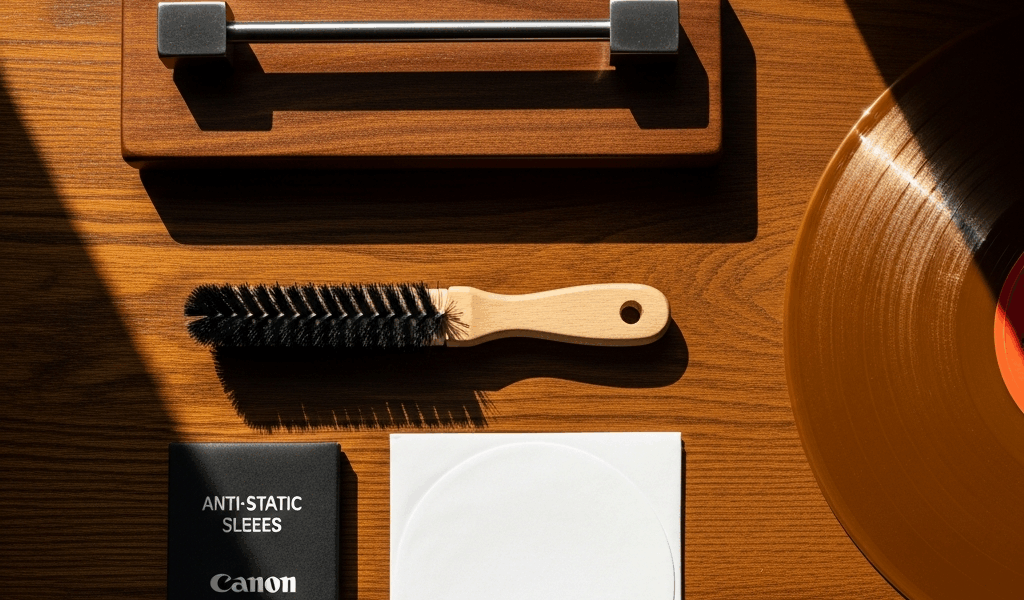
An anti-static brush at $20–30 lives on the turntable and gets used before every record. It’s functional. It’s visible. It shows you understand that dust is the enemy. Velostat makes brushes that actually work. It’s small because it’s specific to the hobby. Avoid generic cleaning products — collectors know the difference between record cleaner and furniture polish.
High-quality record sleeves in bulk — $40–80 for archival sleeves — protect both the record and cover art. Inner sleeves prevent paper dust from reaching vinyl. Outer sleeves preserve the original cover. Collectors think about this obsessively but never actually buy the sleeves themselves. Buying them as a gift frames it as an act of love toward their collection.
A turntable mat upgrade costs $30–60. Felt mats, leather mats, cork mats — each has adherents. The Technics SL-1200 mat is considered the standard. Mats seem cosmetic until they’re not. The difference between a thin stock mat and a proper mat is audible.
Vintage record scales at $25–50 tap into collector mentality. Kitchen scales or postal scales let collectors weigh their entire crate collection, document record store hauls, or just engage in that satisfying ritual of knowing their collection’s total weight. Not essential, but it activates the part of collector brain that loves data.
Experience Gifts Vinyl Lovers Appreciate—
Sometimes the best gift isn’t an object. It’s access.
A record store gift card seems too generic until you frame it correctly. Don’t just hand over plastic. Include a note about a specific album they’ve been hunting for, or mention a record store they’ve talked about. Pair it with a coffee gift card and you’re basically funding a collector’s Saturday morning ritual. Record hunting is as much about the experience as the acquisition.
Vinyl subscription boxes like Vinyl Me, Please or Acoustic Sounds Club run $130–150 for a 3-month gift subscription. These appeal to collectors who want to discover music they might not hunt for themselves. The curation is serious. Labels don’t just send popular records — they include liner notes, interviews, and context. It’s a gift that keeps giving and introduces collectors to rabbit holes they hadn’t explored.
Live music experiences land in this range too. Concert tickets, jazz club memberships, vinyl-themed listening parties. Collectors aren’t obsessed with recorded music alone — many are passionate about the live experience. A ticket to a venue’s listening event where enthusiasts gather to hear a curated album on high-end equipment typically costs $30–100 and activates the community aspect of collecting.
What ties all these gifts together: they respect what the collector actually cares about. Not records as status symbols. Not turntables as aesthetic objects. But the preservation, sound quality, discovery, and ritual that make collecting a genuine hobby instead of just accumulation.



Stay in the loop
Get the latest suggest a gift updates delivered to your inbox.